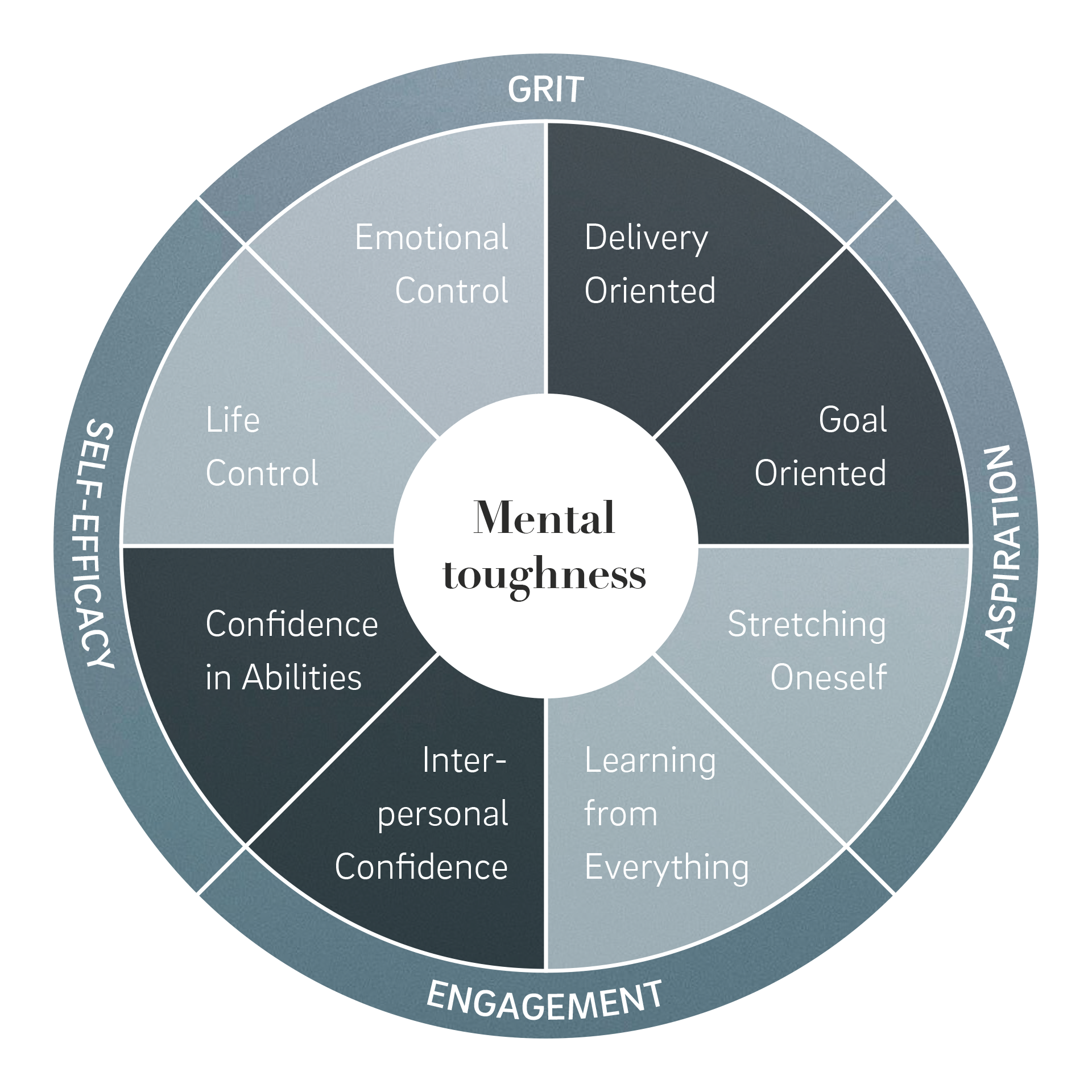
"Mental toughness" gets used loosely in business, usually as a compliment, occasionally as a euphemism for suppressing how you feel under pressure. The research version of the term is far more precise, and far more useful. It's built around four measurable components, commonly known as the 4Cs: Control, Commitment, Challenge, and Confidence.
This framework, developed from decades of psychometric research, has been shown to explain a meaningful share of the variation in individual performance under pressure. That's precisely why it sits at the centre of the Psychological Resilience pillar of our programme.
Control
Control splits into two parts: life control (do you feel you're steering your own circumstances, or reacting to them) and emotional control (can you regulate how you feel and how visibly that shows to others under strain). Leaders low on emotional control aren't necessarily less capable, but their teams often read their visible stress as a signal, accurately or not, that things are going wrong.
Commitment
Commitment covers goal orientation and achievement orientation: essentially, whether you set clear objectives and follow through on them even when the initial motivation fades. This is less about ambition and more about consistency; mentally tough leaders tend to keep promises to themselves, particularly the unglamorous ones nobody's checking on.
Challenge
Challenge is about how you relate to change and risk: specifically, risk orientation and learning orientation. Leaders high in challenge tend to see disruption as an opportunity rather than a threat, and treat setbacks as information rather than verdicts. This is one of the more trainable elements of the 4Cs; it responds well to structured reflection and coaching.
Confidence
Confidence splits into confidence in your own abilities and interpersonal confidence: your capacity to assert a view, hold a boundary, or challenge someone more senior when it matters. This isn't the same as extroversion or charisma. Quiet, highly confident leaders exist in large numbers, and the psychometric measures the underlying trait, not the surface presentation.
Why measuring this matters more than guessing
Most leaders have an intuitive sense of their own strengths and weaknesses across these four areas. But intuition is a poor substitute for measurement, particularly under sustained pressure, when self-perception tends to become less reliable, not more. A validated psychometric assessment gives an objective baseline: not a personality label, but a specific, actionable map of where coaching effort will have the most impact.
Mental toughness has been linked to up to a quarter of the variation in individual performance, making it one of the more consequential, and most measurable, traits in leadership.
In the Brilliance Through Resilience™ programme, this psychometric sits alongside a genetic profile and a 1-2-1 coaching session precisely because a score on its own isn't the point. The value is in what an experienced coach helps a leader do with it.